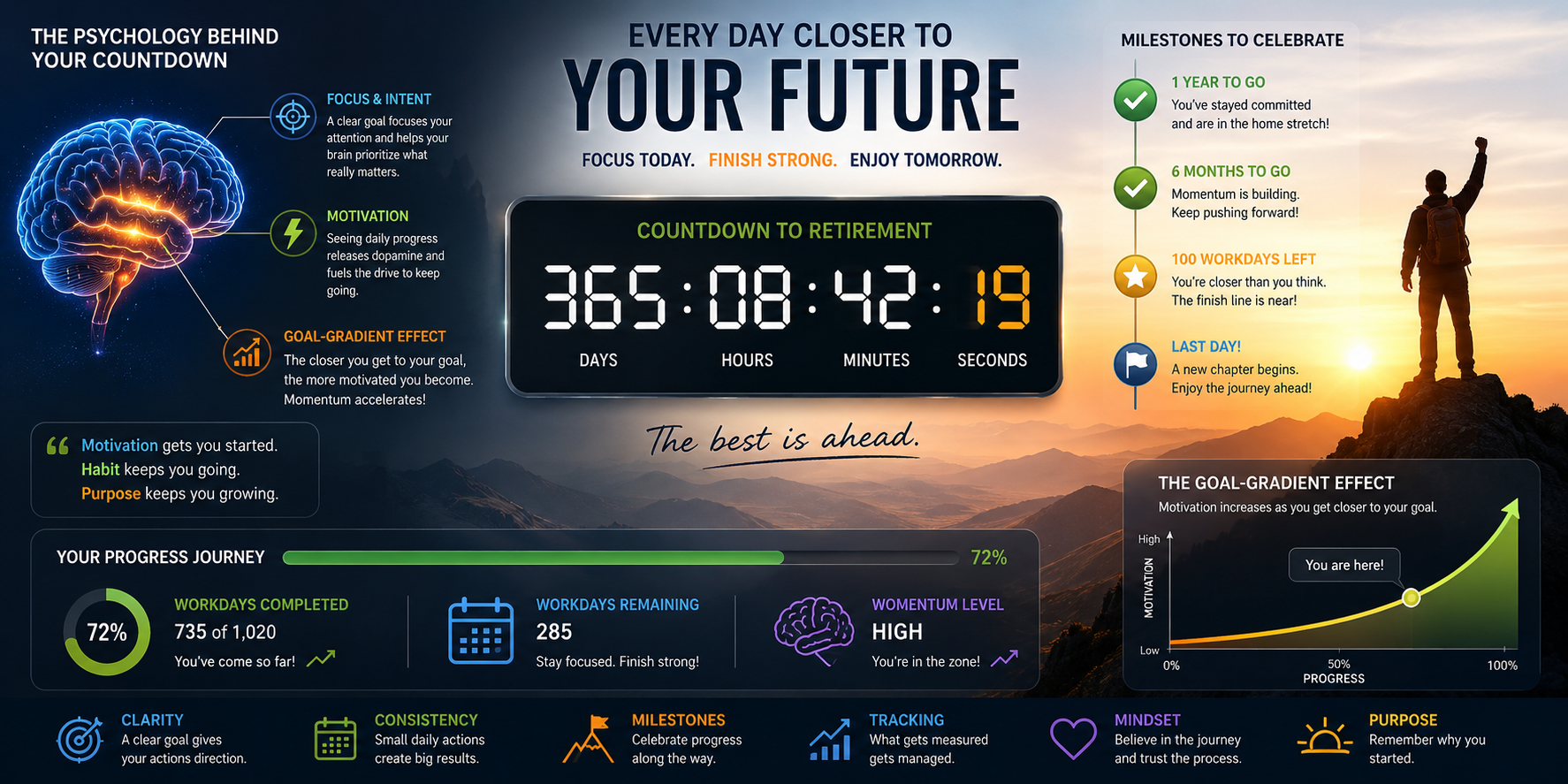
Why do countdown timers work? Why does seeing “1,247 days remaining” feel different from knowing “about 3 years left”?
The answer lies in how our brains process time, goals, and progress. Understanding that psychology is the key to understanding why a retirement countdown app can genuinely change how you approach your retirement.
The Zeigarnik Effect: unfinished tasks stick in your mind
In the 1920s, psychologist Bluma Zeigarnik noticed something interesting: waiters could remember complex orders perfectly — but only until the food was delivered. Once the order was complete, they forgot it entirely.
This became known as the Zeigarnik Effect: our brains hold onto unfinished tasks more strongly than completed ones. An open loop demands attention.
A retirement countdown creates a permanent open loop. Every time you see it, your brain registers “this isn’t done yet.” That gentle mental pressure keeps retirement planning near the top of your mind — not buried under the day-to-day.
The goal-gradient effect: we work harder as we get closer
Research on the goal-gradient effect shows that motivation increases as we approach a goal. People work harder, save more, and focus better when they can see they’re getting closer.
But here’s the catch: the effect only works when you can see your progress. A vague “someday” doesn’t trigger it. A visible countdown does.
When you can see that you’re 90% of the way to your retirement date, the goal-gradient effect kicks in. You naturally feel more urgency, more focus, and more motivation in those final years.
The power of concrete numbers
Our brains are terrible at estimating long time periods. “Three years” feels abstract. “1,095 days” feels real.
Concrete numbers change how we think:
- “About 3 years” → vague, easy to ignore
- “1,095 days” → specific, harder to dismiss
- “247 workdays left” → actionable, easier to plan around
This is why Retirement Counter on Google Play breaks your countdown into years, months, and days. Each level of granularity makes the timeline more real and more useful for planning.
Milestones: the motivation multiplier
The goal-gradient effect works best when goals are broken into smaller steps. That’s why milestone tracking is so powerful.
Instead of one distant finish line, you have:
- Annual milestones — “one year closer”
- Monthly milestones — “another month banked”
- Weekly milestones — “another week in the books”
- Daily milestones — “today counts”
Each milestone is a small win. And small wins are one of the most reliable motivation tools in psychology. They release dopamine, build momentum, and keep you engaged over the long haul.
The planning effect: seeing time makes you use it
There’s one more psychological benefit that’s often overlooked: seeing time makes you plan for it.
When you have a visible countdown, you naturally start asking questions:
- “What do I want to accomplish in my final year?”
- “What projects need to be finished before I leave?”
- “What do I actually want to do with my retirement?”
These questions are the foundation of a good retirement plan. And they’re much more likely to come up when your timeline is visible every day.
Put the psychology to work
You don’t need to understand the science to benefit from it. You just need to put your retirement date where you can see it.
Download Retirement Counter on Google Play and let the psychology of countdowns work for you.